
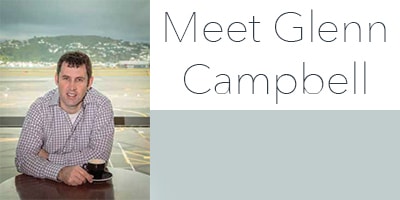
The Kiwi entrepreneur who walked away from corporate life and built a global travel software company
By Glenn Campbell | Originally published 8 September 2014
First published at charteredaccountantsanz.com, thanks to Jennifer Black.
Glenn Campbell CA had the credentials for a comfortable corporate career. He had the talent, the qualifications, and the offers. What he lacked was any desire to take them.
He wanted to build something. The corporate world, as he saw it, was not where that happened.
A difficult time to start out
The sharemarket crash of 1987 hit during Glenn’s first year at university. Like many graduates of that era, he found his entrepreneurial ambitions temporarily shelved. He joined Audit New Zealand and began a career that looked, from the outside, exactly like the one he had been trying to avoid.
But he was not idle. In his spare time, Glenn and his wife spotted a gap in the Wellington market and started making and selling brightly coloured ties. Corporate Wellington in the early nineties was, by his own description, relentlessly drab. The tie business was good enough to help fund the deposit on their first home.
It was a small thing. But it mattered. It showed him what was possible when you backed your own idea.
The idea that started with a wedding in Ireland
Through the mid-nineties, Glenn kept working full time while the internet began to change everything around him. One frustrating experience trying to book travel online for a trip to Ireland became, over time, the seed of a business.
He and his wife Denise, a travel agent by trade, joined forces with an internet-savvy brother-in-law to launch Experience New Zealand Travel (ENZT). The timing was right. Online travel booking was genuinely new. New Zealand tourism was booming, the dollar was low, and American travellers were arriving in numbers.
ENZT did not chase volume. The company focused on bespoke itineraries, boutique accommodation, and genuine New Zealand experiences rather than standard hotel bookings. It was the kind of travel that required real knowledge and careful curation to get right.
The business grew fast. Glenn left National Bank to run it full time, fully aware of what he was giving up.
“A bank is just about moving money,” he said at the time. “I wanted to get back to doing something I had a real passion for.”
Three years in the Deloitte Fast 500
ENZT’s growth earned it a place in the Deloitte Asia Pacific Fast 500 Technology Companies list for three consecutive years. For a business started by a Wellington accountant and his wife, that was a significant achievement.
But growth brought its own problems. As the company expanded, the absence of proper operational software became impossible to ignore. Managing suppliers, tracking rates, assembling itineraries, handling bookings — none of the existing tools were built for what ENZT was doing. The type of company was too new. The software simply had not caught up.
Glenn found two other tour operators facing exactly the same problem. Together, they pooled resources and built their own solution. That solution was Tourwriter.
From internal tool to independent company
Word spread quickly. Within a year, Tourwriter had 25 clients. What had started as a fix for an internal problem was becoming something much larger.
For operators building detailed, custom itineraries for discerning travellers, the appeal was straightforward. The industry had been running on workarounds, spreadsheets, and manual processes. The cost of all that double-handling was real, even if it was rarely measured. Tourwriter gave operators a way to work properly, and they recognised it immediately.
By 2006, Glenn faced a decision. ENZT and Tourwriter were both growing. He could not give both what they needed. He chose Tourwriter and began the process of selling ENZT.
Getting out at the right time
The sale of ENZT did not go smoothly, but it went well enough. Glenn delayed the transaction to base the sale price on the following year’s earnings rather than the current year. It was a calculated risk. By the time he was ready to complete, the global financial crisis was beginning to take shape, and the Australian company that had originally approached him lost its US funding entirely.
Through business contacts, he found a different buyer. Someone who wanted to diversify, and with whom a deal could be done quickly. The preparation work was already complete. The sale went through.
“They just bought at the wrong time,” Glenn said later. “And I got out at the right time.”
Riding out the GFC
Tourwriter was not untouched by what followed. Leads dried up. The company made cuts where it could. Glenn had the capital from the ENZT sale to absorb the pressure, though his co-directors were not in the same position. One went bankrupt. The other sold their business.
Glenn stayed. He believed in what they had built. Tour operators were struggling, but they had not disappeared. He thought the software he had helped develop was exactly what those operators would need when conditions improved.
He was right. When the economy started to recover in 2009, Tourwriter was ready.
Going global
The company had always been intended for an international market. Glenn had known from early on that the real opportunity was not in New Zealand alone. By the time the rebound came, Tourwriter was operating in 25 countries, including Albania, Egypt, Brazil, and Turkey.
Expanding the product to cover group travel opened up a larger share of the market. High-profile clients followed, including All Blacks Tours. The biggest win of 2014 was bringing Tourism New Zealand on board, along with 30 regional tourism organisations.
For operators thinking seriously about which tour operator software to use, the question had always been whether any platform truly understood the complexity of the work. Tourwriter had been built by people doing that work. That difference was visible in the product.
The lessons that stayed
Running your own company means making decisions without much guidance. Glenn has said that some of his greatest lessons came from hiring decisions, and from learning to protect his own time and energy as the company grew.
Tourwriter built a development team across India and the Philippines, working as independent contractors from home. The company was operating across time zones and borders before that was a common way to work.
The hidden cost of manual processes and double-entry in travel operations was something Glenn understood from running ENZT. It informed every decision made in building Tourwriter. The goal was always to reduce the administrative weight on operators, not add to it.
What comes next
In 2014, Tourwriter was looking to open a European office to reduce some of the friction of operating from the bottom of the world. The company was attending major industry events, including World Travel Market in London and ITB Berlin, to build relationships and grow its presence in key markets.
The ambition remained clear. Tourwriter’s goal was to become the leading software for smaller to mid-size tour operators globally. Not just a regional tool. Not just a New Zealand story.
Glenn has always been clear that the company has not yet reached that goal. That honesty is part of what makes the ambition credible.
For those who want to follow his thinking as Tourwriter continues to grow, his writing is available on the Tourwriter blog, alongside the broader resource library for tour operators and travel agents.
He built a software company from a problem he could not solve any other way. That it is now used in 25 countries is, in his own words, proof that a New Zealand software company can do it on the global stage.
He was right about that too.